
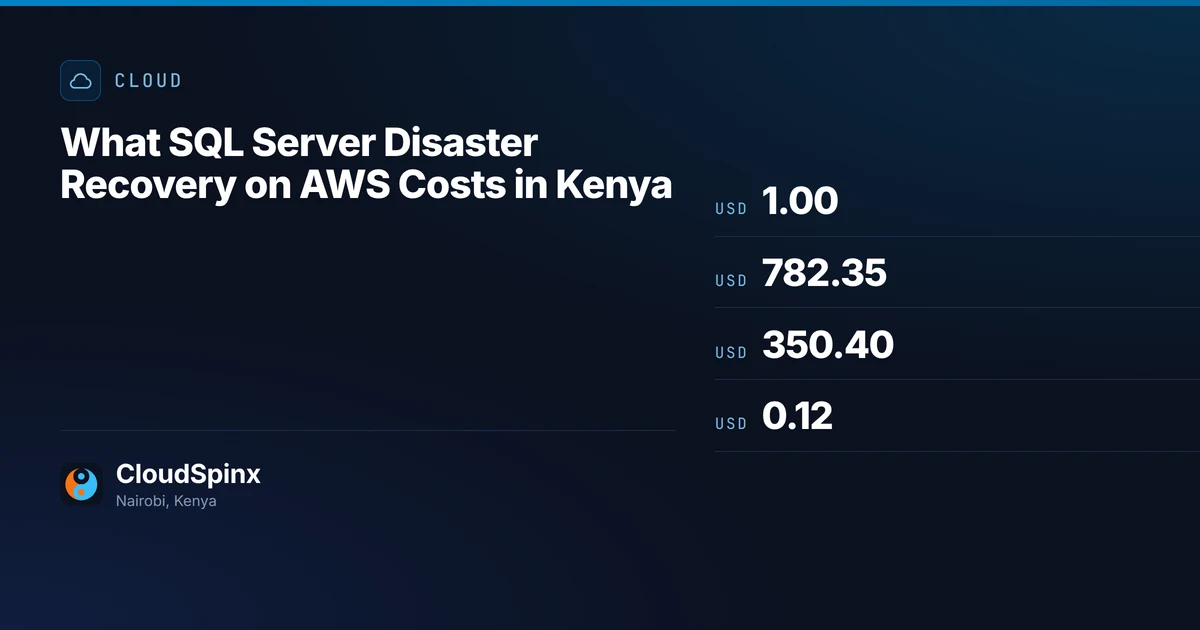
Of the USD 1.00 an hour AWS charges in Cape Town for an r6i.xlarge running Windows and SQL Server Standard, 48 cents is the SQL Server license. Keep that server running as a warm standby with a 500 GB disk and the month comes to USD 782.35, of which USD 350.40 licenses a database nobody queries. That line decides what SQL Server disaster recovery on AWS costs, and whether you can avoid it depends on where your primary runs.
CloudSpinx designs and tests recovery for Windows and SQL Server estates in Kenya through our disaster recovery practice. With no AWS region in the country, a DR site in AWS sits in another one, so we priced Cape Town and the UAE from AWS's published price list, counted what the license costs on every instance type, and read the clauses that decide whether a standby needs one at all. Here are the three shapes we price for a SQL Server DR site, with the arithmetic.
What AWS charges for SQL Server, per vCPU
AWS quotes a license-included instance as one hourly rate, so the license is easy to miss. Subtract the Windows rate from the Windows plus SQL Server rate and divide by the vCPUs. We did that for every on-demand instance type in Cape Town. SQL Server Standard comes to USD 0.12 per vCPU-hour on every type that offers it, and Enterprise to USD 0.375, with one exception that matters for a standby.
The license has a floor. All 30 two-vCPU instance types with SQL Server Standard are charged USD 0.48 an hour for it, the price of four vCPUs, and all 12 two-vCPU Enterprise types are charged for four as well. That matches Microsoft's own rule, which licenses a virtual machine by its virtual cores, "subject to a minimum of four Licenses per Virtual OSE". A two-vCPU standby saves on the server and nothing on the license. The UAE region charges the same license line to the cent, so moving the DR site between the two changes the server underneath and not the license.
| r6i.xlarge in Cape Town, 4 vCPU, 32 GiB | Per hour | Per month, 730 h |
|---|---|---|
| Linux, nothing licensed | USD 0.336 | USD 245.28 |
| Windows Server | USD 0.520 | USD 379.60 |
| Windows plus SQL Server Standard | USD 1.000 | USD 730.00 |
| Windows plus SQL Server Enterprise | USD 2.020 | USD 1,474.60 |
Windows is the smaller line, about USD 0.046 per vCPU-hour, and on a shared AWS instance you cannot bring your own: AWS's licensing FAQ says Windows Server is not eligible for License Mobility. How Windows Server licensing works off AWS, by the core and with CALs, is in our Windows licensing cost breakdown.
Is the passive SQL Server copy free with Software Assurance?
On a server you control, or in Azure, yes. On a shared AWS instance, only when the primary runs in AWS too, and Microsoft's terms and AWS's own FAQ say so in nearly the same words.
Microsoft's Product Terms for SQL Server give each primary covered by Software Assurance two passive copies for disaster recovery: "one on any Server (subject to the Outsourcing Software Management clause)" and one on Azure. Both must be asynchronous and failed over by hand, neither may serve data to users, and a drill may run the primary and a DR copy together "for brief periods of disaster recovery testing every 90 days".
The first copy is the one a Kenyan business would put somewhere other than Azure, and the outsourcing clause decides where it can go: your own server, or one run by an Authorized Outsourcer, which Microsoft defines as a provider that is not a Listed Provider and does not run on one. With Software Assurance that server may even be shared. Microsoft names Amazon as a Listed Provider, alongside itself, Alibaba and Google, so a SQL Server license reaches a shared AWS instance by another route, License Mobility through Software Assurance. The fail-over clause ends by saying these rights "do not apply when Customer deploys SQL Software under License Mobility through SA".
License Mobility carries a fail-over right of its own, and it is tied to production on the same provider: the passive copy's licenses "must not exceed the number of licenses required to run the corresponding production Instances on the same partner's shared servers". AWS's FAQ says the same, counting free passive copies against "the corresponding active SQL Server instances also running on AWS". The sentence you may have read in AWS's cost guidance for SQL Server, "Only the primary/active SQL Server needs to be licensed when you use log shipping with Software Assurance", sits on a page about SQL Server already running on AWS and shipping logs between AWS regions.
So a primary in your own server room with its standby in Cape Town gets no free copy. The standby needs SQL Server licenses of its own, rented from AWS by the hour or brought under License Mobility, and your licensing partner should confirm the count against your agreement before anyone signs.
- free copy, in the terms
- needs its own license
- licensed by the hour
Every free copy has to stay passive, asynchronous and failed over by hand, serving no users, and Software Assurance has to stay active on the primary for any of it to hold.
SQL Server disaster recovery on AWS: three shapes and what each costs
One example runs through all three: a SQL Server Standard primary in Kenya whose standby would be an r6i.xlarge in Cape Town with a 500 GB gp3 volume, on-demand, 730 hours a month. Your sizes will differ. The method will not.
Warm, license included: USD 782.35 a month. The standby runs around the clock, fed by log shipping or an availability group replica, and can take over in minutes. There is no licensing question because AWS bills you the license, USD 350.40 of it every month. On Enterprise the same server is USD 1,474.60 before the disk.
Warm, licenses you bring: about USD 668 a month. AWS bills USD 431.95 for the server, Windows and the disk, and the standby still needs four SQL Server Standard core licenses under License Mobility, which takes Software Assurance or a subscription. Microsoft's published price for a SQL Server Standard subscription is USD 1,418 a year per two-core pack through Volume Licensing, so two packs add USD 236.33 a month, and your agreement and reseller set the real figure. At that price it saves about USD 114 a month against the license-included standby.
Cold, backups only: USD 13.70 a month. Nothing runs. SQL Server 2022 and later back up straight to an S3 URL, and 500 GB in S3 Standard in Cape Town costs USD 0.0274 per GB a month. In a disaster you launch a license-included instance and restore into it, and the USD 1.00 an hour runs only while the instance does, so four eight-hour drills a year cost USD 32 in compute. The catch is recovery time. It is however long your restore takes, and the only honest figure for that is the one you time in a drill. One detail to get right: the region option defaults to us-east-1, so set af-south-1 in BACKUP_OPTIONS for a Cape Town bucket, and in RESTORE_OPTIONS on the way back.
- server (Linux rate)
- Windows license
- SQL Server Standard license
- storage
Cape Town on-demand list prices for an r6i.xlarge with a 500 GB gp3 volume over 730 hours; the instance and disk are an example. The dashed segment is paid to a reseller, not AWS: two Standard subscription packs at Microsoft's published USD 1,418 a year each.
AWS Elastic Disaster Recovery sits between warm and cold. It is USD 0.028 per source server per hour, USD 20.44 a month, plus a small replication server, a staging disk for every source disk and their snapshots at normal EC2 and EBS rates, and no recovery server runs until a drill or a disaster. Its launch settings take care of the Windows license. SQL Server on the recovered machine runs on the license you installed, so running it on a shared AWS instance in a drill or a disaster is a License Mobility question for the same licensing partner.
If you would rather see those lines with your own numbers in them, the DR scoping form takes your data volume and recovery target, the notes box takes the edition and cores, and we run the arithmetic for you.
When the standby should not be in AWS
If you hold Software Assurance and the copy has to be warm, Microsoft's terms point away from AWS: to a second server you own in a second Kenyan facility, where the passive copy is free and the data stays in the country, or to Azure, where the free copy is written into the terms. A Kenyan bank has one more step, because a cloud standby is outsourcing that CBK has to approve before it starts. And if the business can go a day without the database, the cold shape is a bucket, a backup job and a drill on the calendar. You do not need us for that.
The warm shapes are where a wrong licensing assumption costs the most, and where we earn the fee. We run Windows Server and SQL Server estates and price their recovery as one monthly figure. Send the SQL Server edition and version, the cores on the primary, whether the licenses carry Software Assurance, the database size and how long the business can be without it, through the scoping form or on WhatsApp at +254 713 403 044. We send back each shape priced for your estate, and which of them your licenses allow. It is free, and it commits you to nothing.